Evaluating the Efficacy of Virtual Reality Therapy
COURSEWORK
Advances in XR (CS Department)
ROLE
User Researcher, VR Developer
TOOLS
Unity Editor, Figma, Zoom
BRIEF
The objective of this research study is to create a virtual reality (VR) environment that simulates real-life phobia-inducing scenarios and to assess the potential of VR as a tool for therapeutic treatments aimed at reducing anxiety.
WHAT WE DID
I collaborated with a teammate to lead the research project. They worked on developing the VR environment while I conducted the user studies to help us achieve our project goal.
RESULT
-
Customizing VR therapy can significantly boost its usage among patients.
-
Minimizing simulator sickness and enhancing immersion in VR environments are vital for the effectiveness of VR therapy.

CONTEXT
As part of my coursework, I wanted to study Virtual Reality (VR) applications in Human-Computer Interaction. While VR is commonly associated with entertainment, its potential spans across various industries. My goal was to assess the effectiveness of VR therapy and explore the key factors contributing to its successful implementation.
I conducted this study with a focus on replicating three common phobia scenarios (fear of heights, spiders, and public speaking) experienced by people and assessing the factors that contribute to the effectiveness of VR therapy.
Let's dive into my research process
PROCESS
We followed simple steps to ensure the success of this project within the two-month timeframe we had.
Discovery
I researched the challenges in traditional therapy and the prospects of Virtual Reality as a tool for therapy.
Design
We used Figma to design the 2D version of our VR environment, which we later developed using Unity Editor.
User Study
I conducted a mixed-method research using surveys for evaluating simulator sickness and presence, and interview to test the reasoning for the phobia tasks.
Data Analysis
I analysed the collected date by affinity mapping the interview data and visualized the survye data using python.
DISCOVERY
My team began by delving into the current state of Virtual Reality as a therapeutic tool. We accomplished this by examining research papers and experiments from previous years. Additionally, we analyzed articles that compared traditional therapy with VR therapy.
What are the current challenges for VR therapy?
Traditional anxiety therapies like Cognitive Behavioral Therapy (CBT), medication, Psychodynamic Therapy, and Exposure Therapy have their strengths and limitations. Virtual Reality Therapy (VRT), on the other hand, is an innovative method providing controlled exposure to fears in immersive environments. Studies show VRT's efficacy in treating various anxiety disorders, potentially offering better outcomes than traditional therapies due to its engaging nature, but it does pose some challenges.
1. Developing realistic and immersive VR environments that effectively replicate real-world scenarioes
2. The initial costs for equipment, software development, and training can be prohibitively high
3. VR can cause motion sickness, eye strain, and other physical discomforts, which can limit its use for some patients
4. Lack of standardized protocols for VR therapy, making it difficult to compare results across different studies
5. More research is needed to understand the long-term efficacy and safety of VR therapy for anxiety disorders
DESIGN
We created a virtual reality (VR) setup using the Unity editor to tackle acrophobia (fear of heights), arachnophobia (fear of spiders), and glossophobia (fear of public speaking). Each phobia was integrated as a "task" for the participants to undertake. The environment included interactive features like the ability to teleport between tasks using a door and a training room to help participants adjust.

Task 1: Acrophobia (Fear of heights)
"Cross this rope bridge high above a city, and walk back towards the door"

Task 2: Arachnophobia (Fear of spiders)
"Walk through the chamber of freaky spiders"
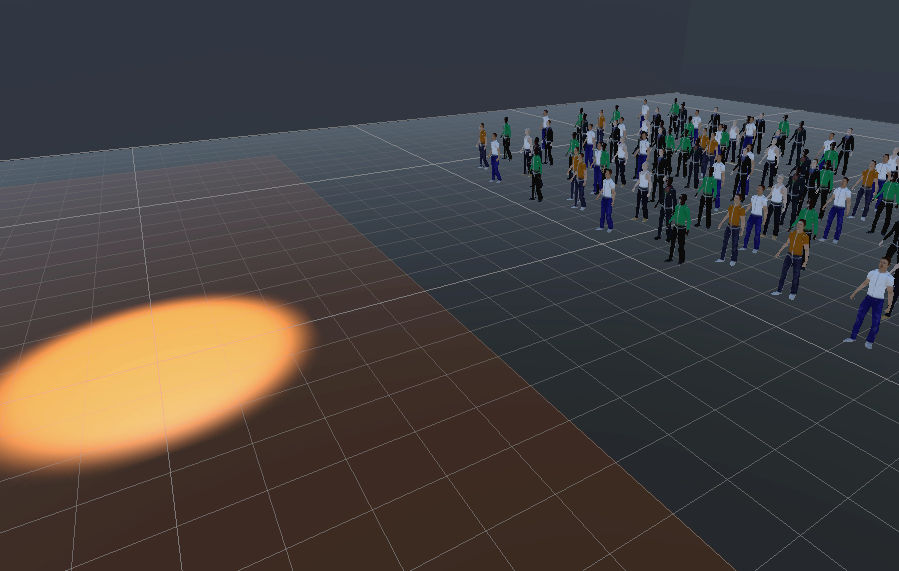
Task 3: Glossophobia (Fear of public speaking)
"Introduce yourself to this impatient audience"
USER STUDY
I moderated the research study, collecting both qualitative data through interviews and behavior observations, and quantitative data through surveys.
Participant Recruitment
We had 16 participants in total, mostly consisting of university students and faculty members. Among the participants, 44% were female and 56% were male, with ages ranging from 18 to 60. Forty-seven percent of them reported having pre-existing anxiety issues, and 27% had previous experience with VR technology.
What was the procedure for the user study?
✏️ PRE-EXPERIMENT ASSESSMENT
The procedure began with a Pre-Assessment, where participants completed a series of validated questionnaires to confirm their eligibility for the study. These initial assessments included measures of anxiety severity, general psychological well-being, and previous exposure to VR technology.
🤸🏻♀️ TRAINING SESSION
Following the pre-assessment, participants underwent a brief training session (untimed play area sorts) for the participant's familiarization with VR equipment and the test environment.
👓 VIRTUAL REALITY EXPOSURE
The core of the study involved VR Exposure, in which participants were fully immersed in thoughtfully created virtual environments representing common situations that are known to trigger anxiety. Throughout the VR exposure, data were gathered using various methods: observing behaviors to track physical responses, conducting structured interviews to collect qualitative data on participants' experiences, and administering standardized surveys to assess simulator sickness, sense of presence, and the coping strategies that were employed.
📝 POST-EXPERIMENT ASSESSMENT
Finally, the study concluded with a Post-Assessment, where participants completed a second set of questionnaires and assessments to evaluate the immediate effects of the VR therapy.

What were the participants' thoughts?
"Being around the jumping spiders gave me tingles, but I did not flinch as I was aware that it was a controlled environment ."
"I did not experience much anxiety in general but I think looking away from the sight causing anxiety and taking a moment was something I did subconsciously . I knew that it was still a virtual environment."
"I did not experience much anxiety in general but knowing that this is a virtual space and is a low-stake scenario was helpful ."
"My fear of heights is less about the distance from the ground and more about the potential of falling/potential of being pushed. So I was able to stand closer to the edge and move with more confidence since I knew that I wouldn't come to physical harm ."
"I did not experience much anxiety in general but knowing that this is a virtual space and is a low-stake scenario was helpful ."
"Immersing myself amongst the spiders was very helpful. Recognizing that they weren't going to come after me helped significantly, and allowed me to look at them in more details ."
DATA ANALYSIS
I used Figjam for qualitative data analysis and Python (pandas library) for survey data visualization.
What was my approach?
I started by assessing the feedback from each participant regarding the individual tasks. Their responses were influenced if they had an existing fear. I identified what worked (triggering fear) and what didn't. In my conclusions, I took into account whether the participant had previous experience with VR to understand how realistic the fear-inducing environment was and how it could be enhanced.

This broad spectrum of simulator sickness experiences emphasizes the necessity for customized adjustments in VR exposure protocols to reduce discomfort and enhance the overall therapeutic experience.
Participant Behaviour and Interviews
The VR simulations effectively triggered fear responses related to acrophobia, arachnophobia, and glossophobia. Some areas could be improved, such as refining the consistency of audio-visual elements and avatar limb representation, integrating gradual exposure techniques, and ensuring uniform behavior of objects in the VR environment.
Simulator Sickness
The assessment of simulator sickness scores revealed significant variation among participants, indicating that individuals had different levels of discomfort when using VR. Scores ranged widely from 0 to 764.97, demonstrating that while some participants felt no discomfort, others experienced significant simulator sickness. This broad spectrum emphasizes the necessity for customized adjustments in VR exposure protocols to reduce discomfort and enhance the overall therapeutic experience.
Sense of Presence
Many participants reported a strong sense of being fully engaged in the VR environment. However, individual experiences varied, influenced by factors such as prior exposure to VR technology and the complexity of the tasks they performed. These findings indicate that while VR can offer deeply immersive experiences, tailoring the experience to individuals and designing tasks carefully are crucial for optimizing the sense of presence and the overall effectiveness of VR therapy.
Main Takeaways
1. The use of Virtual Reality for therapy should be customized and flexible to cater to individual variances in susceptibility to simulator sickness.
2. Adjusting the intensity, duration, and type of VR content can help minimize simulator sickness, improving overall user comfort and engagement.
3. IImplementing gradual exposure protocols for new users can help reduce the onset and severity of simulator sickness.
4. Scheduling regular breaks during VR sessions can help alleviate symptoms of simulator sickness and provide users with necessary rest periods.
Future Work
🔢 INCREASE SAMPLE SIZE
To improve the quality of research data and gain informed insights, it would be beneficial to recruit participants with specific phobias and incorporate their feedback into testing, in addition to traditional methods.
📅 CONDUCT LONGITUDINAL STUDIES
Conducting long-term studies will enable us to assess the long-term effectiveness of VR therapy better, thus providing crucial support for the approach.
🩺 INTEGRATE BIOMETRIC DATA
The integration of biometric devices like heart rate monitors and galvanic skin response sensors can offer real-time physiological data, enhancing the assessment of anxiety levels and the effectiveness of interventions.
🏥 COLLABORATE WITH CLINICAL PRACTITIONERS
Collaboration among clinical practitioners, software developers, and researchers is essential to innovate and refine VR therapy tools, ensuring they meet clinical standards and effectively address the diverse needs of patients with anxiety disorders.
LEARNINGS
Taking a leap into immersive experience design
I decided to take the leap and fully immerse myself in the realm of virtual reality, exploring its practical applications through this project. With a particular focus on VR's potential in healthcare, this endeavor allowed me to translate my foundational skills from the course into real-world scenarios.
Planned and conducted a user study independently for the first time
I've previously organized and conducted user studies in various projects in a team setting. However, this was the first time I put my knowledge into practice independently. I had to consider all potential scenarios when developing the tasks and understand when and what to ask to elicit genuine responses from the participants. It was an excellent learning opportunity.
Got back to coding!
While working on VR development with my teammate, I managed to brush up on my coding skills. It made me feel like an engineer all over again!